What's on the sheet
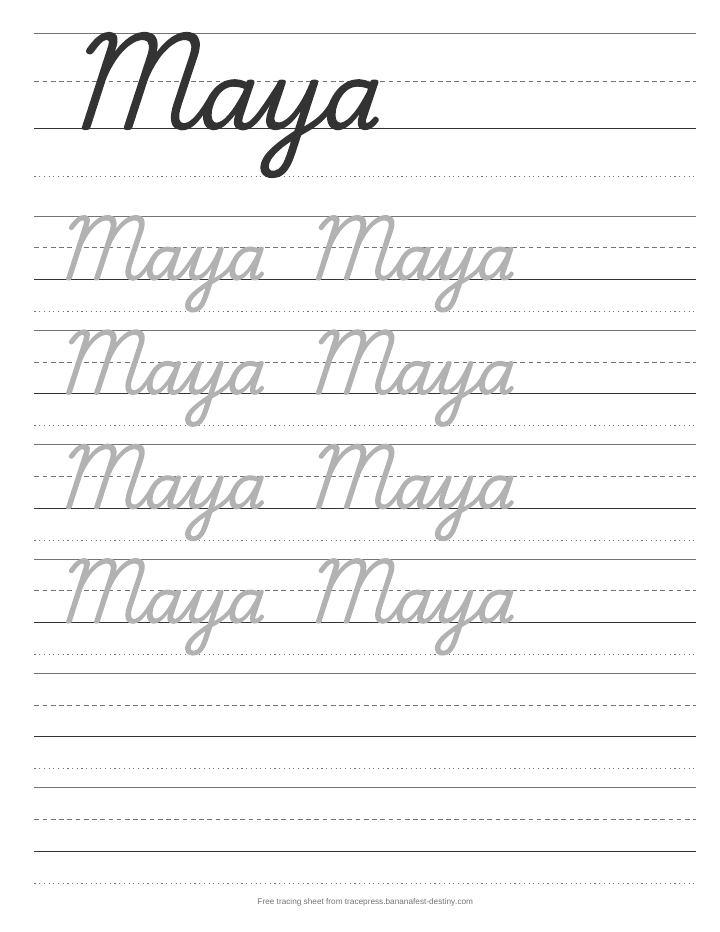
One page, like this one for Maya. The name once, big, in solid cursive, every letter joined to the next the way the font joins it. Then the name in light grey, repeated across each row as many times as it fits, to write over in pencil. The last rows are blank four-line guides: a solid top line, a dashed midline, a solid baseline and a dotted line for tails.
The cursive
The letters are the Playwrite US Trad font, a traditional American cursive, free under the SIL Open Font License: the same cursive as the free cursive A–Z worksheets. There are no start dots or stroke arrows in cursive: the solid name at the top is the model. Schools that teach a different cursive model will show some capitals differently.
How a name fills the sheet
The line size sets how many rows fit on the page, and the name's length sets how many times it fits across a row. Here are Maya (four letters) and Christopher (eleven) in cursive on a US Letter sheet. The last column is the size of the solid name at the top, against Maya's.
Christopher keeps its full size at the top on every line size except 1", where it is drawn at 74%. On the print sheet the same name drops to 44% at 1" and 57% at 0.75". Cursive also fits more across a row: at 0.45" lines, Maya fits four times in cursive and three times in print.
Letters it draws
Capitals A–Z, lowercase a–z, the accented letters in names like Sofía, José, Zoë, Noël and Ñúñez (á é í ó ú ý, à è ì ò ù, â ê î ô û, ä ë ï ö ü ÿ, ã õ ñ, å, capitals too), and the numbers 0–9, up to 16 characters and spaces. Hyphens, apostrophes, ç, ø and æ are drawn too, so "Mary-Kate O'Neil", "François" and "Søren" trace as spelled; ß, œ and other punctuation aren't drawn yet. The note under the name box says when something was left out.
Making a whole book?
Trace Press makes a full A–Z letter tracing workbook in this same cursive, or in print, plus its cover, laid out to Amazon KDP's rules so it can be sold as a paperback. It's free to try; $19 once makes it ready to sell. Or see a finished book first.