Free printable alphabet chart
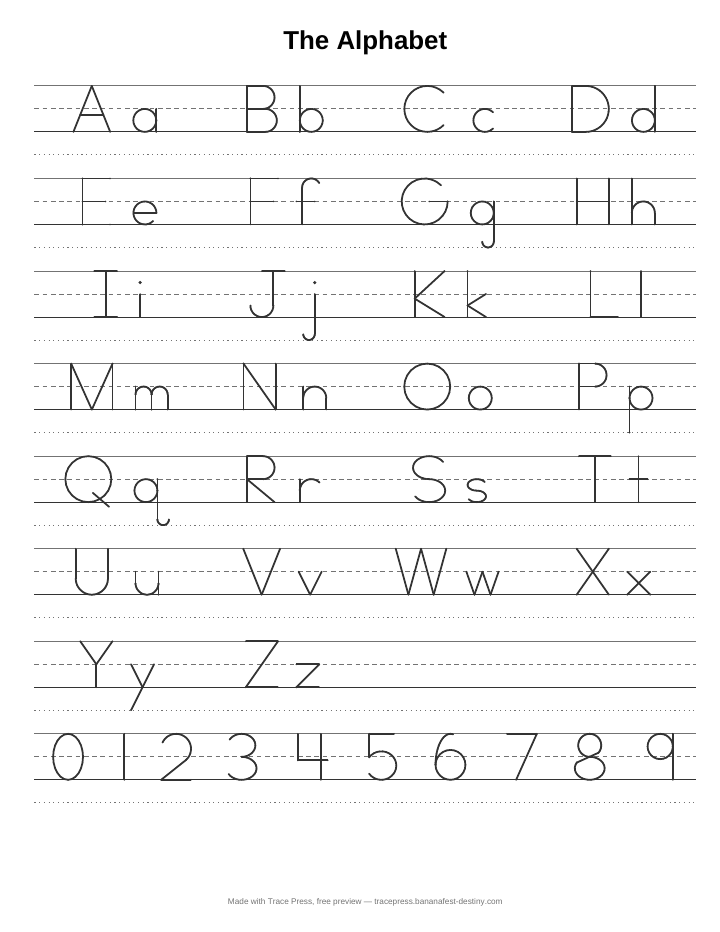
Every letter of the alphabet in print on one page: the capital and the lowercase letter side by side, A to Z, then the numbers 0 to 9, on handwriting lines. The letters are the shapes a child is taught to write, not a book typeface.
 Download the chart (PDF, one page)
8.5" × 11", about 47 KB, no sign-up. A small footer line says where it came from.
How the letters are drawn
Each letter on the chart is drawn from the same strokes as the Trace Press tracing pages, as solid lines, so what a child copies here matches what they trace there. A few of them don't look like the letters in a printed book:
- a, d, g and q are each a circle with a straight line down its right side. The a and g are the simple, one-part shapes, not the typed “a” and “g” with a hook over the top or a second loop.
- g and q are told apart by their tails: g's tail curls to the left and q's curls to the right.
- b and p are a line first, then a bump on its right side, so they mirror d and q.
- Capital I has a bar across the top and the bottom. Lowercase l and the number 1 are both one straight line from the headline to the baseline, so on the chart they look the same.
- 4 is open at the top, 7 has no bar across its middle, and 9 is a circle with a straight line.
Schools use different handwriting models, so compare the chart with the one your child's school uses before you pin it up.
What is on the chart
- All 26 letters as pairs, Aa to Zz, four to a row.
- The numbers 0 to 9 along the bottom, spaced apart so they read as separate numbers.
- Four-line handwriting guides under every row: a top line, a dashed midline, a solid baseline and a dotted line for tails.
To practise the letters
The letter tracing worksheets give each letter its own page, with numbered start dots and arrows for the order of the strokes, then rows to trace. For joined letters there is a cursive alphabet chart laid out the same way.
The chart inside a workbook
If you're making a tracing book to sell on Amazon KDP, Trace Press can put this chart in the book as its first page of practice, in the book's own trim size. In a cursive book it uses the cursive chart instead. It counts as one of the book's 52 extra pages, so the largest book stays at 78 pages. The guide to making a tracing book for KDP covers the rest of the book.